The Surplus Split Kit
The BudgetRock plan for giving every spare dollar one job at a time: a starter buffer, the debts, the full emergency fund, then the next project, paid in cash
BudgetRock's Monthly Budget Calculator ends with what is left after the month's bills. Then our Emergency Fund, Debt Payoff and Savings Goal calculators each ask for your monthly amount on their own, and nothing checks that the three add up. Type the same surplus into all three and each gives a hopeful date; together they spend the money three times. The Surplus Split Kit does the adding up. In its worked example a household with $4,600 a month take-home sees a $950 surplus, but $2,520 of yearly bills leaves a true surplus of $740. The three calculators, each given the full $950, promised a three-month fund in 10 months, no debt in 13 and a $6,000 patio in 7: $2,850 a month from $950. Given one job at a time, the $740 builds a starter buffer by month 3, clears four debts by month 18 (avalanche $1,191.76 of interest, snowball $1,362.03, and you choose), fills the full fund by month 25 once every freed minimum rolls in, and pays for the patio in cash by month 31. On a 22.9% card the same patio would cost $1,629.87 in interest. Every worked figure is an example you replace with your own. The kit gives no investment advice, recommends no product or provider, assumes no return on savings, and checks every debt against its interest line: where a payment does not beat the interest, it points you to a nonprofit credit counselor. You get a 24-page printable PDF with seven steps, a surplus sheet, a debt list, a one-job plan, a monthly check-in, reference tables and a quickstart, plus a personalised sheet worked out from the numbers you entered in our calculators.
Look inside
Two full pages from the kit, exactly as printed. Click either to read it at full size before you decide.
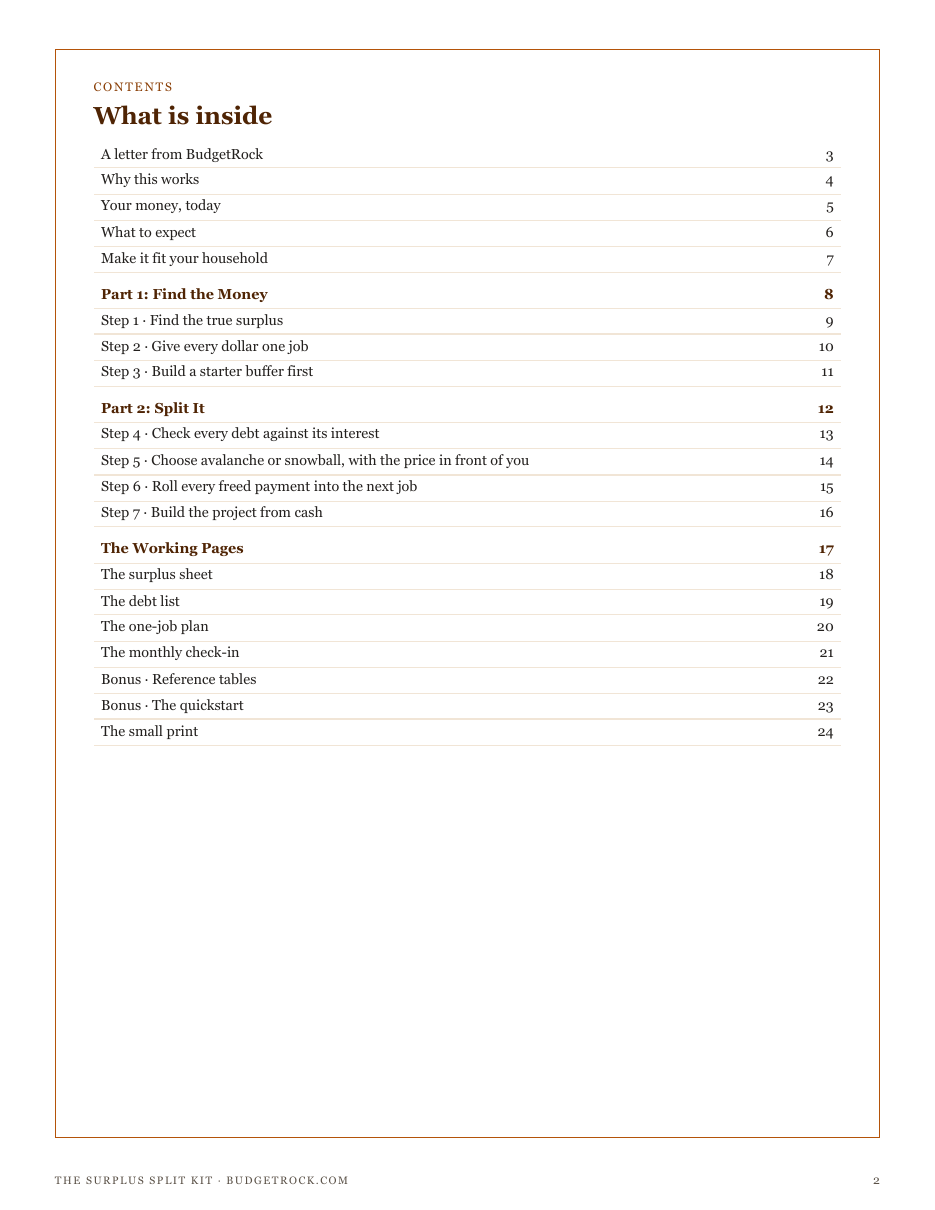
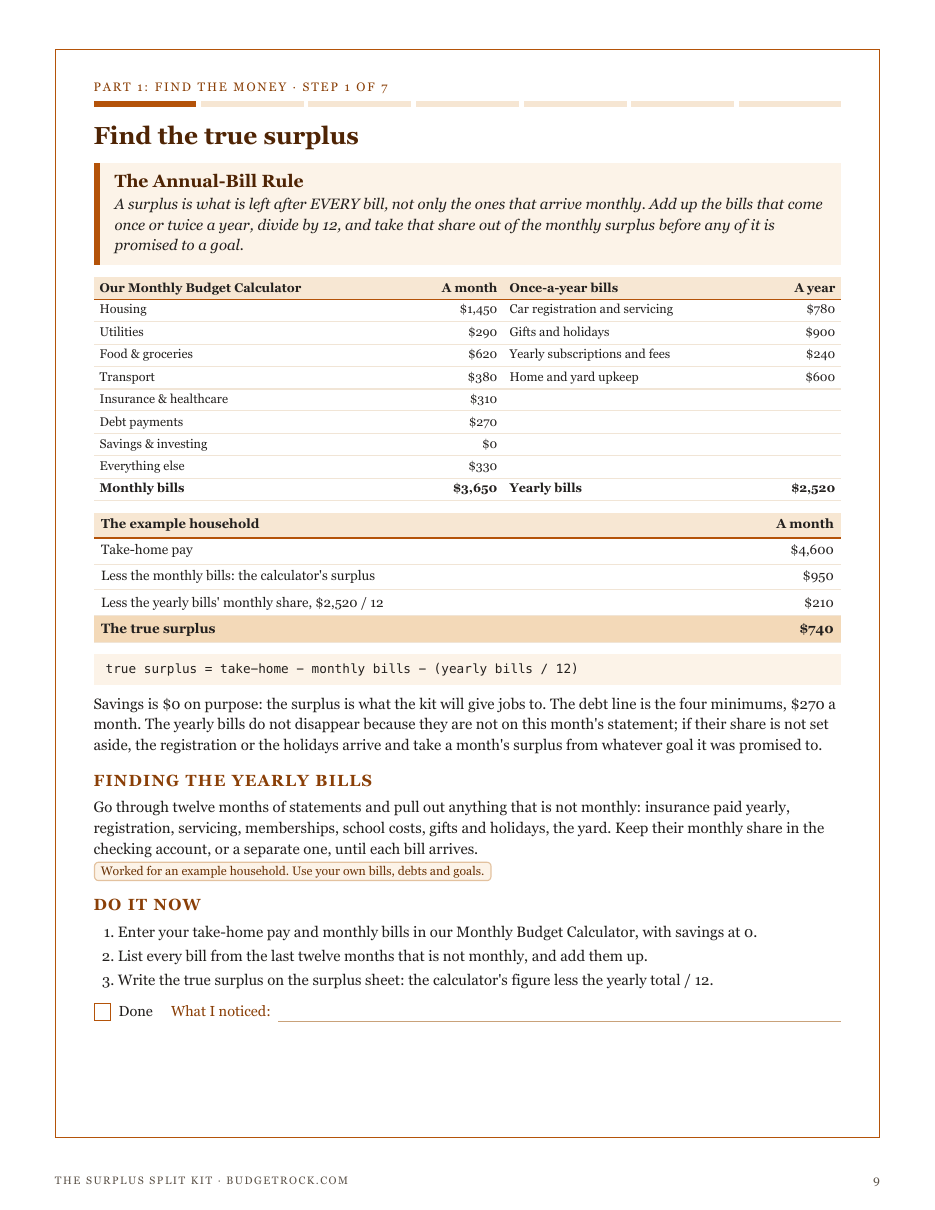
What is in it
- The true surplus: the monthly budget's figure less the yearly bills' monthly share
- One job per dollar: why three calculators' dates cannot all happen, and the 50/30/20 bucket they share
- The starter buffer: one month of essentials first, and other reasonable starting points
- The interest line: every debt's payment against its monthly interest, and when to call a nonprofit credit counselor
- Avalanche or snowball: both priced on your debts, with the dollar difference, and how to choose
- The rollover plan: each freed payment moves to the next job, with a month for every finish
- The project from cash: financed versus saved, and what a split really costs
- Working pages: a surplus sheet, a debt list, a one-job plan and a twelve-month check-in
- Reference tables: months to save with no return assumed, months to clear $1,000, emergency fund targets
- A quickstart, and a personalised sheet worked from the numbers you entered
- ✓ 24 printable pages
- ✓ 10 sections, worksheets and templates
- ✓ A second PDF worked out from the numbers you enter
- ✓ No account needed, just an email address
- ✓ Instant download; link valid 7 days
Price includes any taxes. Sold by GrabURL, who handle checkout and support. The charge appears on your statement as GrabURL.
The kit picks up where the free Monthly Budget Calculatorleaves off. The calculator prints what is left after the month’s bills; the kit takes the yearly bills’ share out of it, checks that the amounts typed into our emergency fund, debt payoff and savings goal calculators add up to that one surplus rather than each equal it, builds a starter buffer, checks every debt’s payment against its interest, prices avalanche and snowball side by side so you can choose, rolls each freed-up payment into the next job, and prices a project both financed and saved in cash. It gives no investment advice, recommends no product or provider, and assumes no return on savings; if your payments do not cover your interest, it points you to a nonprofit credit counselor. The worked figures are examples; your own numbers replace them.